
Credits: Equinox
How Performance, Science and Technology Are Redefining the Industry
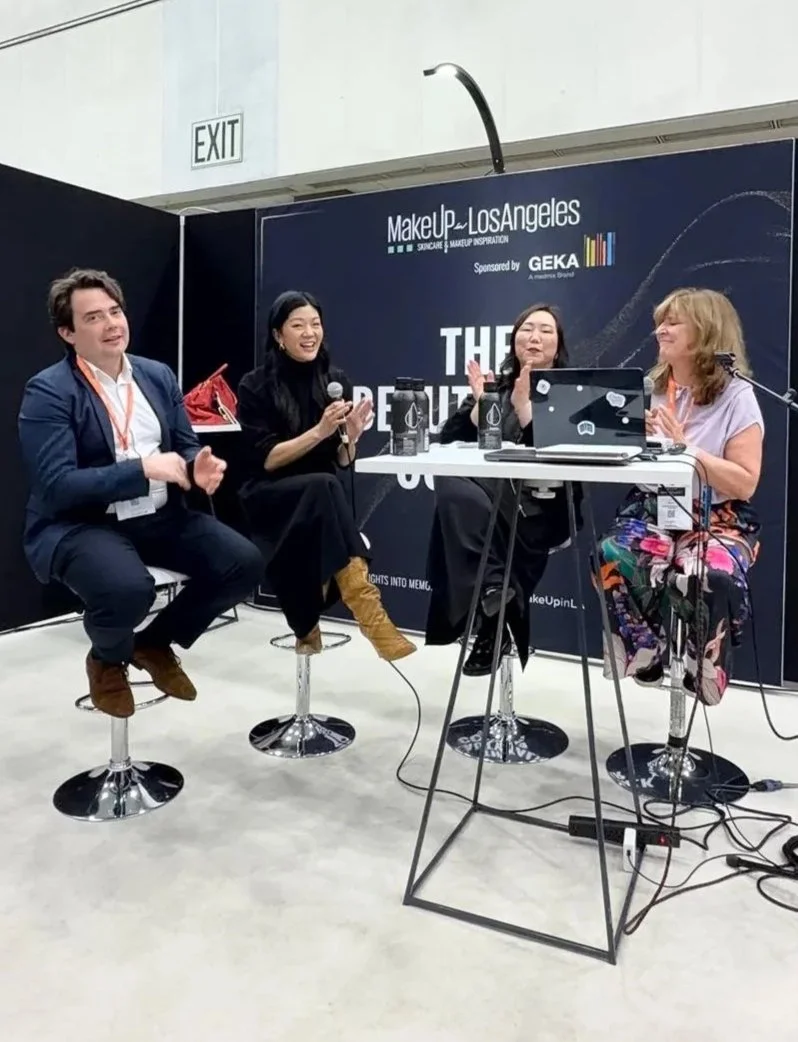
At MakeUp in Los Angeles, Cosmetics Inspiration & Creation hosted the first session of its Beauty Talk series, exploring how the industry is entering a new phase defined by performance, efficiency and technological integration.
Moderated by Leila Rochet, founder of Cosmetics Inspiration & Creation, the session titled “The Optimization Era: How Beauty Is Evolving Toward the Next Level of Efficiency” brought together Gloria Ryu, Chief Product Officer at Haus Labs by Lady Gaga, Michelle Lee, founder and CEO of Monologue and former Editor-in-Chief of Allure, and Max Farrow, Marketing Director at Nuon Medical.
Together, they explored how beauty is shifting from aspiration and storytelling toward measurable performance systems, driven by science, devices, and increasingly sophisticated consumer expectations.
Entering the Age of Flow
To frame the discussion, Leila Rochet introduced the broader cultural context shaping the beauty industry today. Cosmetics Inspiration & Creation’s latest foresight report, The Age of Flow, highlights a world defined by constant acceleration and adaptation.
Technological intensity, AI-driven systems, climate instability and evolving social norms are transforming consumer expectations. Beauty is no longer static or purely aesthetic, it is becoming adaptive, experiential and performance-driven.
Within this landscape, Rochet identified the rise of what Cosmetics IC calls the Optimization Era, where beauty intersects with wellness, sports science and longevity culture.
Consumers increasingly approach beauty as a performance ecosystem, combining skincare, devices, lifestyle habits and recovery strategies.
Performance Becomes the New Beauty Standard
For Gloria Ryu, the transformation of Haus Labs illustrates how deeply the industry is shifting toward science-led product development. When she joined the brand five years ago, the mission was to reposition the company from a celebrity-driven label into a true innovation platform.
“We saw that the market was clearly shifting from a concept-led approach to a more performance-led one.” - Gloria Ryu
The repositioning required rethinking the entire product ecosystem, from ingredient selection and formulation to packaging design and testing protocols. Today, performance is validated through rigorous real-world stress testing, including stage testing with Lady Gaga and professional dancers to ensure products remain “life-proof.”
The goal, according to Ryu, is to operate at the intersection of science and artistry, using technology to enhance creative expression rather than replace it.
The Rise of the Performance Consumer
Michelle Lee offered a perspective from her experience in editorial and brand development.
Over the past decade, the beauty consumer has become increasingly aware of ingredients and scientific claims. However, Lee emphasized that performance remains the ultimate decision driver.
“Ultimately it still comes down to the user experience- how well something works.” - Michelle Lee
Consumers may be more informed than before, but scientific storytelling must remain accessible and emotionally engaging. For brands, this means balancing clinical credibility with compelling narratives, ensuring that science supports the experience rather than overwhelming it.
Devices and Technology Redefine Efficacy
Another major dimension of the Optimization Era is the growing convergence between cosmetics, medical technology and engineering. Companies such as Nuon Medical are pushing this shift by integrating clinical-grade technology directly into consumer beauty products, enhancing the performance of formulations and accelerating innovation cycles.
As Max Farrow explained, technology is not only improving product efficacy, it is also transforming how quickly innovations can be developed and brought to market.
“We are shortening the route to market, developing functional prototypes in days instead of months.” - Max Farrow
This acceleration reflects a broader shift in the industry, where beauty is increasingly treated as a high-performance system combining formulation, device technology and real-time development capabilities.
Science Is Raising the Bar for Innovation
As scientific literacy grows, both product development and marketing standards are evolving rapidly. Ryu noted that the modern beauty consumer is far less tolerant of vague scientific language or borrowed credibility.
“Consumers are much less tolerant of vague scientific language, you need to be able to prove what you say.” - Gloria Ryu
This shift is forcing brands to invest more heavily in testing, validation and R&D partnerships in order to build lasting credibility. In many ways, the industry is entering a phase where innovation must be both visible and provable.
The Strategic Challenges Ahead
Looking forward, the panelists identified several major challenges shaping the future of beauty innovation.
Hyper-Accelerated Innovation
Technology, AI and global beauty ecosystems are compressing product development cycles while raising expectations for differentiation.
Global Influence
K-Beauty, J-Beauty and emerging international markets are reshaping ingredient culture, textures and product formats at unprecedented speed.
The Battle for Attention
As Michelle Lee noted, beauty brands are no longer competing only with other beauty brands.
“Our competitors today are not just other beauty brands, they’re anything that takes attention.” - Michelle Lee
Social platforms, streaming services and digital culture are redefining how brands must capture and sustain consumer interest.
The Future: Beauty as a Performance System
As the discussion concluded, one message became clear: beauty is evolving into a holistic performance system. Products, devices, wellness rituals and technology are converging to deliver optimized outcomes across skin, body and lifestyle. For brands, the challenge will be not only to innovate, but to do so with clarity, authenticity and measurable impact.
As Gloria Ryu summarized, the future of beauty will depend on maintaining the courage to innovate deeply rather than superficially.
“As the market gets smarter, superficial differentiation gets exposed faster.” - Gloria Ryu
In the Optimization Era, true innovation will belong to brands capable of combining science, performance and meaning into one coherent system.
The cic take
The Optimization Era signals a structural shift in how value is created in beauty. Performance is no longer a differentiator, it is the baseline. What will define the next generation of leaders is the ability to orchestrate ecosystems rather than products - combining formulation, devices, data, and experience into cohesive, outcome-driven systems.
The risk ahead lies in over-indexing on technology at the expense of meaning, or conversely, relying on storytelling without substance. In a landscape where consumers are both highly informed and attention-fragmented, only brands that can align credibility, clarity, and cultural relevance will sustain impact.
Ultimately, the Optimization Era is not about doing more, but about doing better, with precision, coherence, and intention.
To learn more about the agency’s latest report, contact our team.